


Meet-Cute on the Stoop: NYC Love Stories
- Mana Faye
- Jan 5
- 5 min read

New York enclaves hold space for intercultural couples.
Edited by Andriana Kourkoumelis
On a summer day in 2023, Geormary Sanchez, 29, walked into Mushtari Coffee Shop in Harlem and ordered her usual, a lavender latte. She and the new barista, Hamza Sarr, 30, stole glances and made light conversation as he frothed the milk. “It’s on the house,” he said with a smile as he handed her the drink. She left the shop with the taste of lavender still on her tongue and a warm, unexplainable feeling. Three months later, they were married.
Sanchez grew up nearby in Spanish Harlem, in a big Dominican family, with bachata as the soundtrack of her childhood. Sarr, a first-generation Gambian-American, was born and raised in Little Senegal, just a few streets down.
Two years into their marriage, they’re still living in Harlem, the city they know best, where their lives are intertwined and they can remain tied to their cultures.
Like Sanchez and Sarr, interracial or interethnic relationships are increasingly common in New York, with roughly 18% of people in metro areas married to someone of a different race or ethnicity, compared with 11% in non-metro areas, according to Pew Research Center. Despite New York City often being referred to as the “worst” city for dating, there remains a significant group of couples that fall in love within the bounds of their diasporic communities.
These communities, made up of multi-generational immigrants who clustered in various neighborhoods, created what sociologists call ethnic or cultural enclaves. These pockets offer something that dating apps can’t: shared values, familiar rituals, and an unspoken understanding.
They also have a flavor that’s very New York. These enclaves hold space for intercultural couples, where one partner adopts the neighborhood’s traditions, while the pair still carries practices from their own backgrounds, creating a cultural exchange.
Little Senegal in Harlem, the Caribbean community in Jamaica, Queens, and the Latino community in Washington Heights are just a few examples. For these couples, love isn’t just a swipe on an app — it’s shaped by their homeland identities and their neighborhood’s landscape.

Bah and Clarence when they first started dating (Courtesy of Kadia Bah and Josh Clarence)

Dorettea and Wendell Boyce in 2000 (Courtesy of Dorettea and Wendell Boyce)

The Boyces in 2025 (Courtesy of Dorettea and Wendell Boyce)
Kadia Bah and Josh Clarence: Rooted in Bed-Stuy, Connected to the Diaspora
On a cold, crisp November morning, Kadia Bah, 28, a Fulani woman from West Africa, and Josh Clarence, 31, an African American man, met at the Museum of African Diaspora in San Francisco. It wasn’t just her thick braids or quiet confidence that caught his attention, but the shared space, a celebration of Black identity, history and diaspora.
A year later, they moved to Bedford-Stuyvesant, a historically Black neighborhood in Brooklyn, intentionally choosing a space where conversations about African culture didn’t need explanation, so they could explore their love without the disturbance of a white lens.
Their daily life blends Fulani and African American traditions: Bah cooks attiéké, mafe and yassa — all dishes from her childhood. Clarence shares soul food staples like chicken and waffles, and introduces Bah to American rap history, pop culture references and slang. Their early mornings start with walking their dog and brewing Café Touba, a traditional West African coffee drink. Evenings include cultural events to Afrobeats concerts. They volunteer weekly at a local church food pantry and attend film screenings that celebrate the African diaspora.
“Our relationship is a little cultural melting pot, a mini diasporic world,” Bah said. “Being in Bed-Stuy, surrounded by our community, keeps us rooted,” Clarence added.
“At the end of the day, we’re two first-generation kids figuring it out,” Sarr said. “Harlem is what keeps us grounded.”
Hazma Sarr
Dorettea and Wendell Boyce: A Guyanese Love Across the Boroughs
On July 1, 1998, Dorettea sat on the steps of her home on Cortelyou Road in Flatbush, Brooklyn. It was a warm summer afternoon. The air was clean and smelled of Haitian patties coming from the Caribbean restaurant next door.
Wendell, passing by to visit an unbeknownst mutual friend, noticed her immediately. That first afternoon stretched into three hours of laughter over Stamppot, a Surinamese dish of vegetables, sausage and mashed potatoes.
Twenty-five years and two children later, Dorettea and Wendell live in Jamaica, Queens, a predominantly Caribbean neighborhood. Their Guyanese heritage guides everyday life, from weekly visits to Sybil’s and Little Guyana bakeries, to long drives and neighborhood parties. Their Guyanese heritage is central to their everyday lives, and the couple says their cultural roots heavily influenced their connection early on.
“Growing up in Guyanese households, we learned from a young age that respect, loyalty and togetherness were instrumental in relationships with people,” Dorettea said. “So naturally, that commitment influenced how we showed up for each other. We have learned to communicate on a different level while respecting each other. Growing up, love was shown through a meal or simple gestures. That has been at the forefront of our relationship, and we always make sure we show up for each other.”

Hamza Sarr and Geomary Sanchez enjoy the day together in Morningside Park, Harlem, on August 10, 2025. (Courtesy of Geomary Sanchez and Hamza Sarr)

The couple celebrates after Sarr’s Tapestry of Cultures exhibition in Chelsea on Oct. 25, 2025. (Courtesy of Geomary Sanchez and Hamza Sarr)
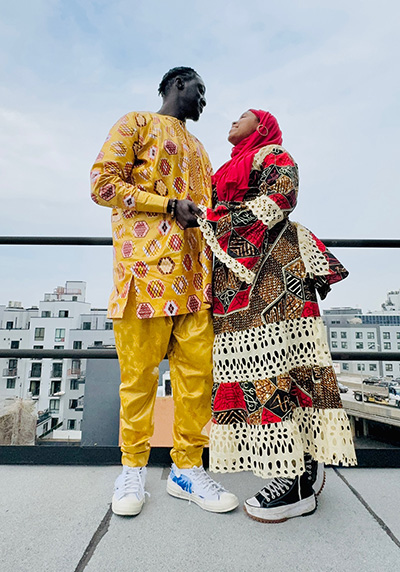
Sanchez and Sarr the AREA 17 rooftop in Brooklyn, August 10, 2024. (Courtesy of Geomary Sanchez and Hamza Sarr)
Geomary Sanchez and Hamza Sarr: Growing in Harlem, Connected Through Culture
“I’m Dominican and I had Dominican friends, but I was the weird one,” Sanchez said. “I talk different, I dress different. I was always just open to different interests.”
Sarr said he felt the same sense of difference, and it became a bonding aspect in their relationship.
“We both grew up in Harlem, but in totally different cultural pockets,” he said. “I grew up basically in Little Senegal, and she didn’t even really know that area existed. But somehow it still felt like the same Harlem to both of us.”
That shared understanding helped them see beyond traditional expectations. “We just don’t stereotype,” Sanchez said. “We don’t fall into any of that or try not to.”
While they prioritize roles based on their Muslim faith, where the male partner often takes the financial and decision-making lead, they acknowledge that living in an expensive city like New York requires adjustment. They believe in interdependence, where each person isn’t obligated to do certain tasks, but they fill gaps for each other based on their strengths.
Their first-generation experience also impacts the way they view mental health. Sarr revealed that his parents knew about a necessary cornea procedure, and didn’t want him to get it due to their fear of the unknown. This was something that he carried with him, but with Sanchez’s encouragement, now he is becoming more open to addressing it head-on.
“I was super anti-medication,” Sarr said. “But with Geomary, and with faith, we were able to tackle issues like that together, and work on our mental health.”
Both Sanchez and Sarr are challenging their cultural norms in the way they approach these conversations now. Topics like medication and therapy are very easy for them to talk about, which they both acknowledge might be considered “crazy” by their parents, they explain.
Today, the couple has a joint Instagram account called @thatharlemlove, where they share their daily lives and the evolution of their love story. Most recently, the couple celebrated Sarr’s photography and film project, Tapestry of Culture, at a Harlem art exhibit that brought together a collective of African, Arab, and North African artists.
“At the end of the day, we’re two first-generation kids figuring it out,” Sarr said. “Harlem is what keeps us grounded.”


